LLM Models
Claude 4.x (Anthropic via direct API or AWS Bedrock), GPT-4 / GPT-4o / o1 (Azure OpenAI), Gemini 2.x (Vertex AI), open-source: Llama 3.x, Mistral / Mixtral, Qwen 2.5.







AI Enterprise services
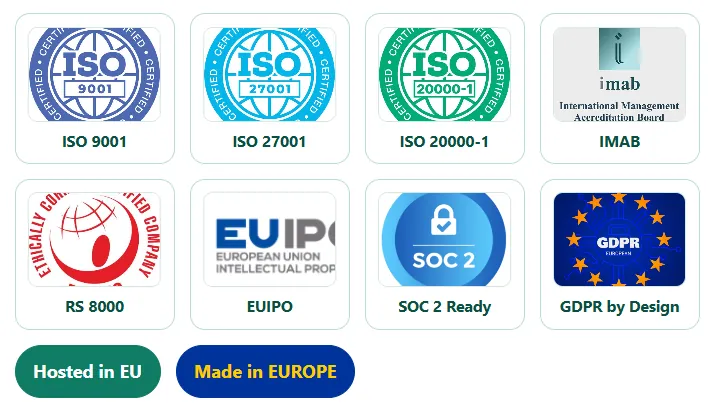
VOGO builds AI solutions for enterprise clients: chatbots with RAG (retrieval-augmented generation), autonomous agents with tool calling, document intelligence, computer vision, predictive analytics, complete MLOps. We use Claude (Anthropic), GPT-4 / Azure OpenAI, Gemini and open-source self-hosted models (Llama, Mistral). Compliant with EU AI Act, EU hosting, on-premises or private cloud deploy on request.
Why enterprise AI
The difference between an AI demo and an AI system that runs in production 24/7 is enormous. VOGO builds on the other side — AI systems with observability, continuous evaluation, fallback rules, audit trail, compliance. Not "magic boxes".
For 90% of enterprise needs, RAG (Retrieval-Augmented Generation) is the right pattern — not fine-tuning, not pretraining. The LLM answers based on your data (internal documents, knowledge base, databases), extracted at runtime from a vector database. Citable answers, with sources, minimal hallucinations.
We build eval datasets before writing code. Every change in prompt, model, or retrieval is evaluated on that dataset — not "works on my ad-hoc test". We use Promptfoo, LangSmith, automated evaluations with LLM-as-judge plus human evals on sensitive cases.
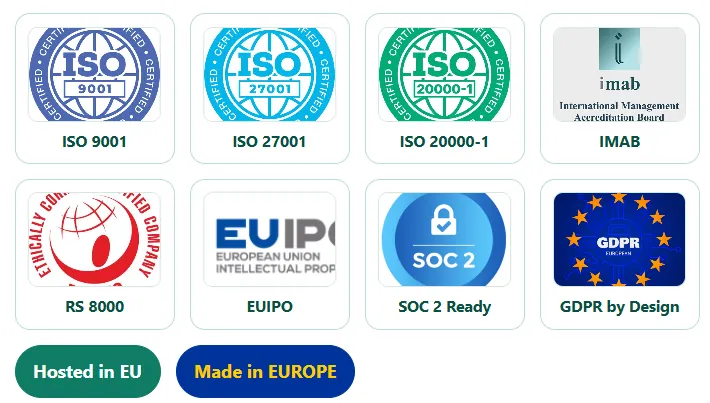
EU AI Act is in force. We classify your system (minimal / limited / high-risk), build the required technical documentation, implement human-in-the-loop where regulation requires it, audit trail for every automated decision, transparency to the end user. It's not optional — it's an obligation.
Default: Azure OpenAI West Europe (EU data residency), Claude through AWS Bedrock EU, or self-hosted models (Llama 3, Mistral) on dedicated GPUs in EU or on-premises. PII redaction before any LLM call. Audit trail per request. Your data does not train third-party models.
What we deliver
Our differentiators on applied AI.
2-4 wks
Functional PoC for a RAG chatbot or document intelligence
EU AI Act
Technical documentation and risk classification by design
Eval-driven
Eval dataset on each project — no silent regressions
Self-hosted
On-premises open-source models for sovereignty requirements
Use cases
Internal assistant (HR, IT, knowledge base) or external (customer support) that responds based on your documents. Automatic ingestion (PDF, DOCX, Confluence, SharePoint), intelligent chunking, vector embedding, hybrid search (BM25 + semantic), automatic citing, escalation to human.
Automatic processing of contracts, invoices, forms, reports. Structured extraction (entities, values, clauses, signatures), validation with business rules, integration directly into ERP/CRM. Reduces manual data entry by 70-95% on typical processes.
AI agent that receives a task and executes it multi-step: searches information, calls APIs, modifies data in systems, generates report. Use cases: ticket triage, automated procurement, weekly report generation, customer onboarding.
Defect detection on the production line, OCR on scanned documents / field photos, video analytics for retail (heatmap, customer counting). Custom models (YOLO, Detectron2) or cloud (Azure Vision, AWS Rekognition, Google Vision).
Product demand forecasting, customer churn prediction, predictive maintenance on equipment, fraud detection in transactions. Stack: Python + scikit-learn / XGBoost / LightGBM, time series with Prophet / ARIMA / NeuralProphet, deploy via MLflow.
We build the missing MLOps infrastructure: feature store, model registry, experiment tracking, CI/CD for models, A/B testing, drift and performance monitoring. Stack: MLflow, Kubeflow, SageMaker, Azure ML, Vertex AI.
Stack & integrations
Claude 4.x (Anthropic via direct API or AWS Bedrock), GPT-4 / GPT-4o / o1 (Azure OpenAI), Gemini 2.x (Vertex AI), open-source: Llama 3.x, Mistral / Mixtral, Qwen 2.5.
Pinecone, Weaviate, Qdrant, Milvus, Azure AI Search, pgvector (PostgreSQL extension). Hybrid search (BM25 + semantic), metadata filtering, multi-tenancy.
LangChain, LangGraph (agents), LlamaIndex, Haystack, Semantic Kernel (Microsoft), Anthropic SDK, OpenAI SDK. Streaming, tool calling, structured output (JSON schema).
Python, PyTorch, scikit-learn, XGBoost, LightGBM, Prophet (forecasting). Computer vision: OpenCV, YOLO v8/v10, Detectron2.
MLflow, Kubeflow, Weights & Biases, SageMaker, Azure ML, Vertex AI. Feature store: Feast, Tecton. Eval: LangSmith, Promptfoo, Ragas.
PII redaction (Microsoft Presidio), prompt injection defenses, jailbreak monitoring, audit trail per request, granular RBAC, secret management (Key Vault), EU AI Act documentation framework.
How we work
Short PoC, rigorous eval, gradual scale. We don't start with "let's just throw GPT at it".
We identify the real use case, measurable success criteria, available data, compliance restrictions (EU AI Act, GDPR).
Minimal end-to-end build on a sample of real data. Eval dataset built. Demo with metrics. We decide GO / NO-GO based on data.
Architecture for scale: vector DB, ingestion pipeline, eval pipeline, monitoring, fallback rules, human escalation.
Iterations with automated eval at each push. You see metrics at each iteration: accuracy, latency, cost-per-call.
Risk classification, technical documentation, human-in-the-loop if required, transparency to user, audit trail.
Progressive deploy (canary), drift and hallucinations monitoring in production, recurring eval, automatic retraining trigger.
Frequently asked questions
Cloud (Claude, GPT-4, Gemini): for implementation speed and maximum quality on complex tasks.
Self-hosted (Llama, Mistral, Qwen): for data sovereignty requirements or predictable cost at scale. Deploy on dedicated GPU (vLLM, TGI, Ollama) on-premises or in EU.
Hybrid is the most common approach: cloud models for complex tasks, self-hosted for volume tasks (classification, embeddings).
RAG (Retrieval-Augmented Generation) = the standard pattern for LLMs that answer based on YOUR data.
Instead of fine-tuning the model (expensive, rigid, harder to update), you feed it at runtime with relevant fragments extracted from a vector database.
Advantages:
Agents = LLMs that don't just respond, but execute actions:
We use Claude tool use, OpenAI function calling, LangChain, LangGraph.
Use cases: ticketing automation, procurement, report generation, internal employee assistant.
Hosting: Azure OpenAI West Europe (EU data residency), Claude through AWS Bedrock EU, or self-hosted models on-premises.
PII redaction before any LLM call (Microsoft Presidio or equivalent).
Audit trail per request, granular RBAC on documents.
EU AI Act:
We always start with an evaluation phase (1-2 wks) to validate feasibility before committing to large scope.
Next step
Private session with a VOGO consultant specialized in enterprise AI. We respond on the same business day.
A private session — phone or WhatsApp. We respond on the same business day.
Or email us: info@vogo.family
Coverage