Backend
.NET 8 / C# (ASP.NET Core, Minimal APIs), Java 21 / Spring Boot 3, Node.js (NestJS, Express), Python (FastAPI, Django). gRPC, GraphQL, REST.




Software Enterprise services
VOGO builds enterprise software end-to-end: multi-tenant SaaS platforms, microservices, cloud-native apps, internal portals, data platforms, legacy application modernization. Mature stack (.NET, Java Spring, Node.js, Python), deploy on Azure, AWS, GCP, DevOps by default.
Why enterprise custom software
For an enterprise, off-the-shelf software solves 80% of needs. The remaining 20% — the part that differentiates you in the market, where you have competitive advantage — requires custom development. VOGO helps you build that 20% correctly, without rewriting what a commercial product already does.
We don't rewrite a CRM if Salesforce / D365 does the job. We don't rewrite an ERP if SAP / Oracle is already in house. We build the custom part — your specific workflows, your business rules, the missing interfaces — and integrate them with existing systems. Less code written, less to maintain.
Apps run in containers (Docker), orchestrated with Kubernetes (AKS, EKS, GKE) or on App Service / ECS Fargate / Cloud Run when appropriate. For clients with data sovereignty requirements, we deploy on-premises or on private clouds (OpenStack, VMware Cloud).
CI/CD pipeline from day 1, Infrastructure as Code (Terraform, Pulumi, Bicep), monitoring and alerting (Application Insights, Datadog, Grafana), centralized logging (Loki, Elasticsearch), distributed tracing (OpenTelemetry). We know software in production, not just at demo.
The same team that wrote the code also operates it — you build it, you run it. There's no "handover to operations" model where nobody understands the code anymore after 6 months. Maintenance is done by people who know the history of decisions.
What we deliver
VOGO's differentiation vs a generic dev-shop.
Senior-only
Core team is 8+ years experienced engineers — no junior bench
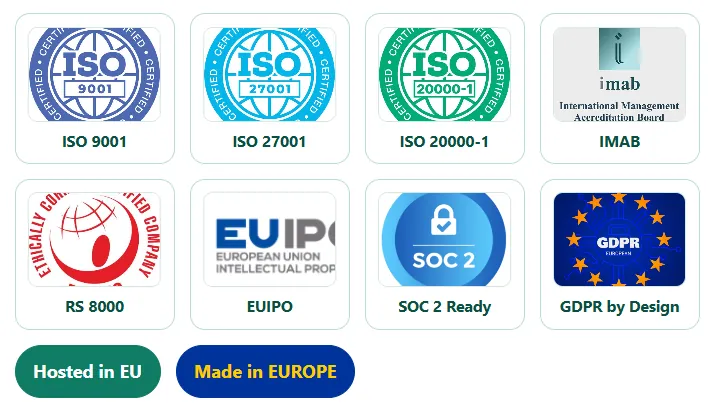
ISO 27001
Security standards applied by design — audit-ready
SLA 99.9%
Standard SLA 99.9% uptime; 99.95% on premium contracts
2 weeks
Standard iteration — demo at the end, feedback in next
Use cases
Below are the most common categories. We have real cases delivered for each.
SaaS application offered to your clients, with per-tenant isolation (database-per-tenant or shared-DB schema-per-tenant), automatic billing (Stripe Billing, Chargebee), multi-tenant admin panel, audit log per action. Stack: .NET / Node.js + PostgreSQL + Kubernetes.
Old monolithic application (.NET Framework, Java EE, PHP 5) migrated to modern architecture: strangler pattern, gradual rewrite, no big-bang. New code runs in parallel with old, target migrated progressively.
Portal for employees (request management, knowledge base, announcements, onboarding) or customers (account, documents, invoices, support). SSO via Microsoft Entra / Okta, integration with existing HR / billing / CRM systems.
Centralized data lake or data warehouse (Azure Synapse, Snowflake, BigQuery, Databricks), ELT pipelines (Fivetran, Airbyte, custom), semantic modeling (dbt), dashboards (Power BI, Looker, Metabase), data governance.
Business workflow automation platforms (procurement, contracts, approvals, customer onboarding). Built on BPM engines (Camunda, Temporal, Apache Airflow) or custom. Integration with legacy systems via API gateway.
Internal platform for a vertical domain (healthcare, finance, logistics) with proprietary business rules, specific compliance (HIPAA, PSD2, KYC/AML, eIDAS), audit trail, regulatory reporting.
Stack & integrations
Mature stack, no hype. We choose technology by problem, not by trend.
.NET 8 / C# (ASP.NET Core, Minimal APIs), Java 21 / Spring Boot 3, Node.js (NestJS, Express), Python (FastAPI, Django). gRPC, GraphQL, REST.
React, Next.js 15, Angular, Vue 3 / Nuxt. Design systems (Material UI, Ant Design, Radix UI, custom), state management (Redux Toolkit, Zustand, TanStack Query).
PostgreSQL (preferred), SQL Server, MySQL, MongoDB, Redis (cache + queues), Elasticsearch / OpenSearch (search + log analytics).
Azure (preferred — App Service, AKS, Functions, Service Bus), AWS (ECS Fargate, EKS, Lambda), GCP (Cloud Run, GKE). IaC: Terraform, Pulumi, Bicep.
CI/CD: GitHub Actions, Azure DevOps, GitLab CI. Monitoring: Application Insights, Datadog, Grafana. Logging: Loki, Elasticsearch. Tracing: OpenTelemetry.
OWASP Top 10 + ASVS by design, SAST (SonarQube, Snyk), DAST, dependency scanning, secrets management (Azure Key Vault, AWS Secrets Manager, HashiCorp Vault), mandatory code review.
How we work
Short iterations, regular demos, infrastructure provisioned from code — not from clicks in console.
Workshops with your team, domain map (Domain-Driven Design — bounded contexts), integration identification, NFRs.
C4 model diagram, ADRs (Architecture Decision Records), PoC on risky parts (complex integrations, performance-critical paths).
Git repository, IaC (Terraform), CI/CD pipeline, dev/stage/prod environments, secrets management, monitoring and alerting.
2-3 week iterations, demo at the end, integrated feedback. Mandatory code review, automated testing > 70% coverage on new code.
End-to-end testing with real users, penetration testing (internal or with third-party firm), load testing, rollback plan.
Progressive deploy (blue-green or canary), intensive monitoring, operational runbook, SLA-backed maintenance contract. Shared on-call if you want.
Frequently asked questions
We work on:
We don't work on standalone Windows desktop apps. For mobile see Mobile App Enterprise.
Backend: .NET 8 (C#), Java Spring Boot, Node.js (NestJS), Python (FastAPI, Django).
Frontend: React, Next.js, Angular, Vue 3.
Database: PostgreSQL, MySQL, SQL Server, MongoDB, Redis.
Cloud: Azure (preferred), AWS, GCP. Containerization: Docker, Kubernetes (AKS, EKS, GKE).
We almost always start from a modular monolith — a single deployable, but with modules clearly separated at code level (bounded contexts).
We recommend microservices only when there are clear reasons:
We don't push microservices where they don't belong — they double operational cost (network, observability, debugging).
Yes, by default. Each project starts with:
Without DevOps, enterprise software doesn't run in production — operating cost becomes prohibitive.
Depends drastically on scope:
We work in 2-3 week iterations with regular demo — you receive value along the way, not at the end.
The code belongs to you 100% — in your repository, under the agreed license in the contract (usually proprietary).
We also transfer:
We can continue maintenance, or transfer it to your team with formalized knowledge transfer (4-8 weeks).
Next step
Private session with a VOGO consultant specialized in enterprise software. We respond on the same business day.
A private session — phone or WhatsApp. We respond on the same business day.
Or email us: info@vogo.family
Coverage