
Registers are configured, not coded
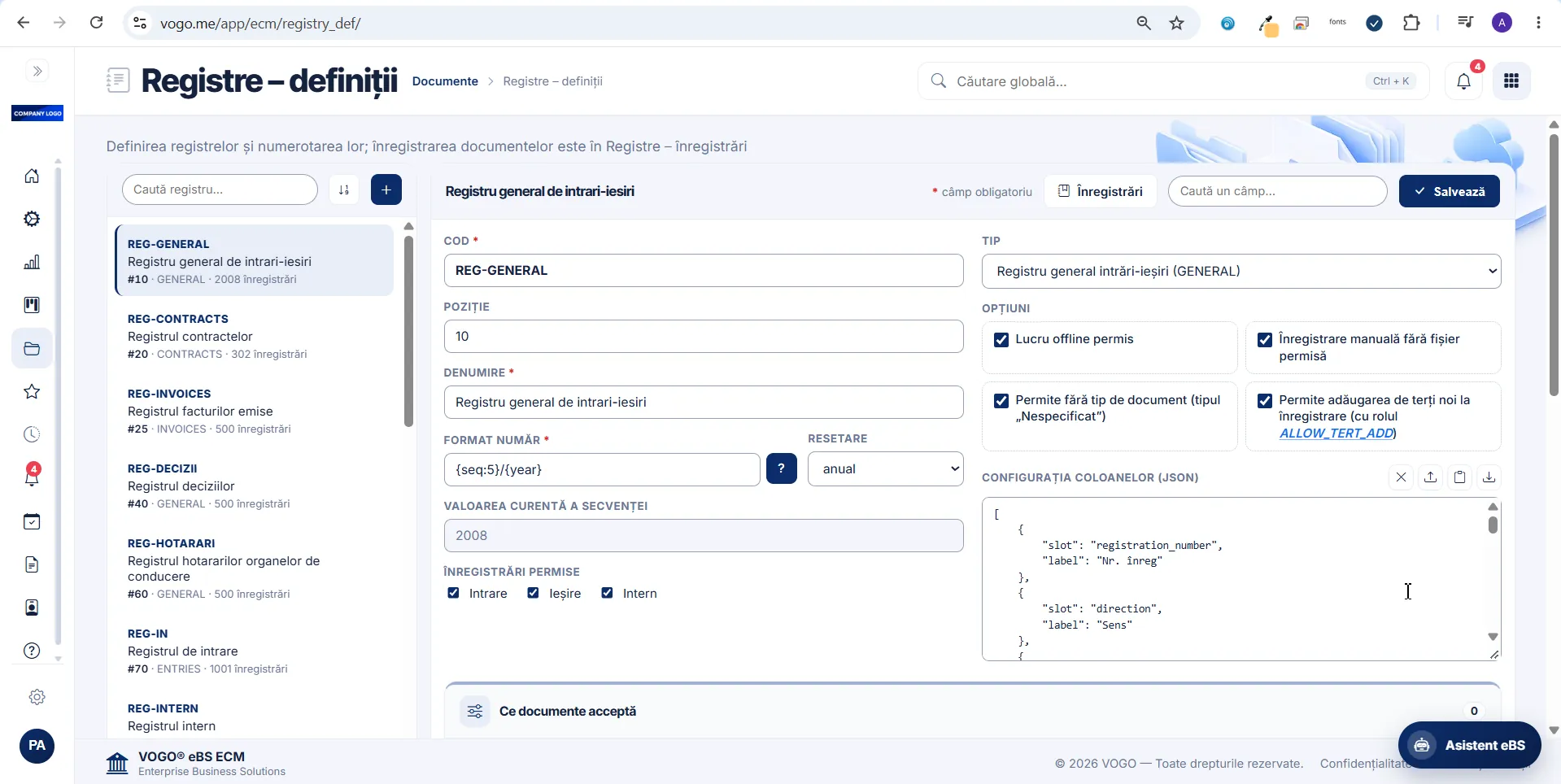
Every register carries its own code, number format, yearly sequence reset and the entry types it allows — incoming, outgoing, internal. Its columns and the documents it accepts are configured from the same page.








VOGO eBS e-Registratura
Digitise the flow of documents from registration to archiving, in one secure, easy-to-use platform.
Document registration, electronic registers, workflows, deadlines, audit and archiving — in one system.
EUIPO EUTM 019103505The electronic registry through which the organisation manages all of its document registers in one place, from intake to archiving. Registration numbers are assigned automatically by the system, according to the rules defined for each register, and every document keeps a complete history of the operations performed on it.
An entry never disappears from the system. Corrections, cancellations and changes stay traceable, together with the user, the date and the time at which they were made. This way the institution keeps permanent control over the flow of documents and can quickly check who registered, changed, viewed, assigned or closed an entry.
The platform manages several registers in the same application, each with its own code, its own yearly numbering, its own document types and its own access rights. The general registry, contracts, petitions, decisions, resolutions, urban planning, personnel or the archive can all be run in one coherent system that is easy to follow.
Fewer manual operations. Fewer errors. Full traceability for every document.
Every register carries its own code, number format, yearly sequence reset and the entry types it allows — incoming, outgoing, internal. Its columns and the documents it accepts are configured from the same page.
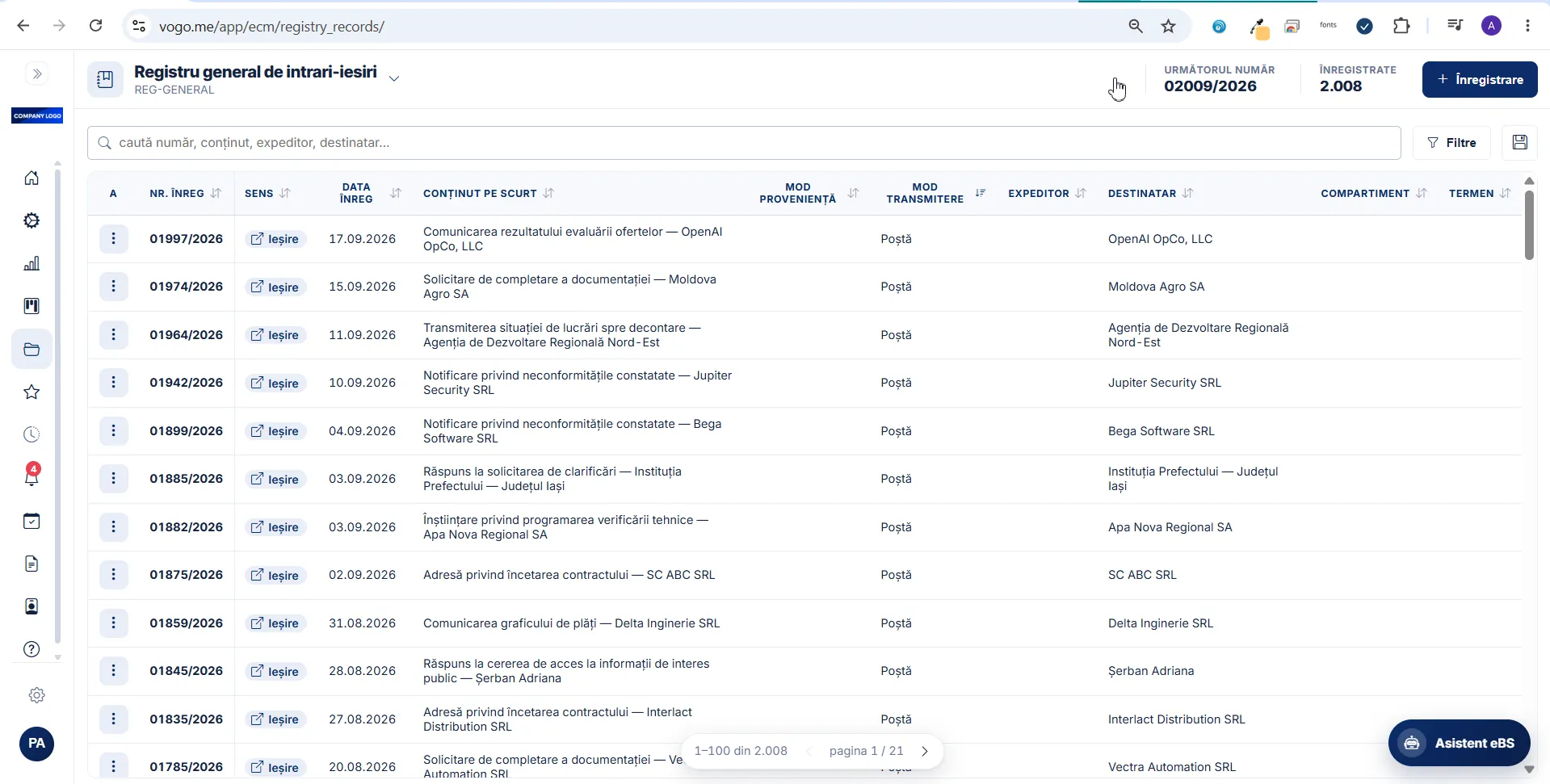
Direction, date, short content, sender, recipient, department and deadline, all on the same entry. The next number is visible before the entry is created, and search and filters run across the whole register.
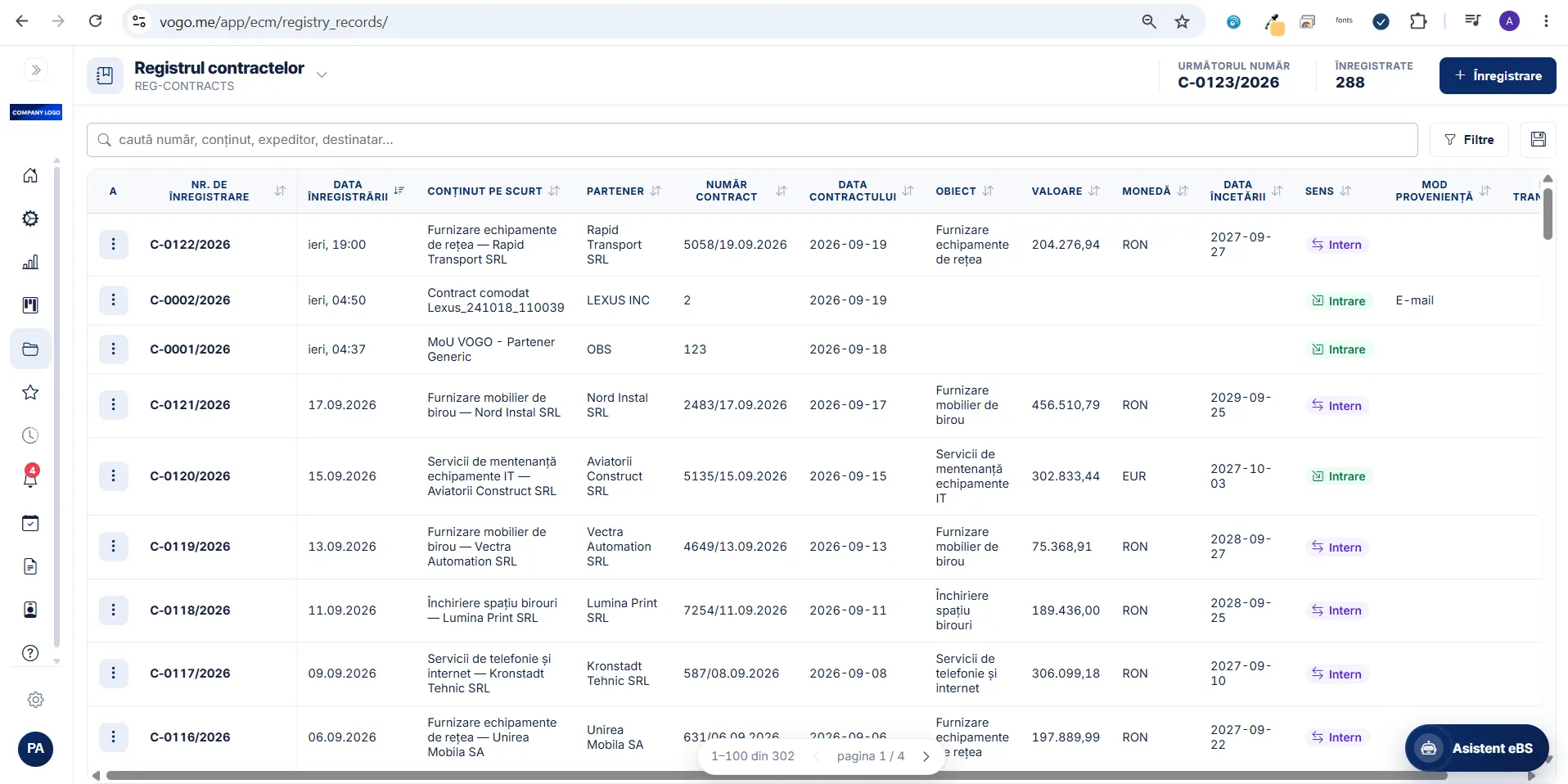
The contracts register does not carry correspondence fields: partner, contract number and date, subject, value, currency and end date. The same numbering rules, a different set of data.
The main file and the attachments are read on the right, while the origin, the supplier and the invoice data are filled in on the left. The registration number and date stay unchanged.
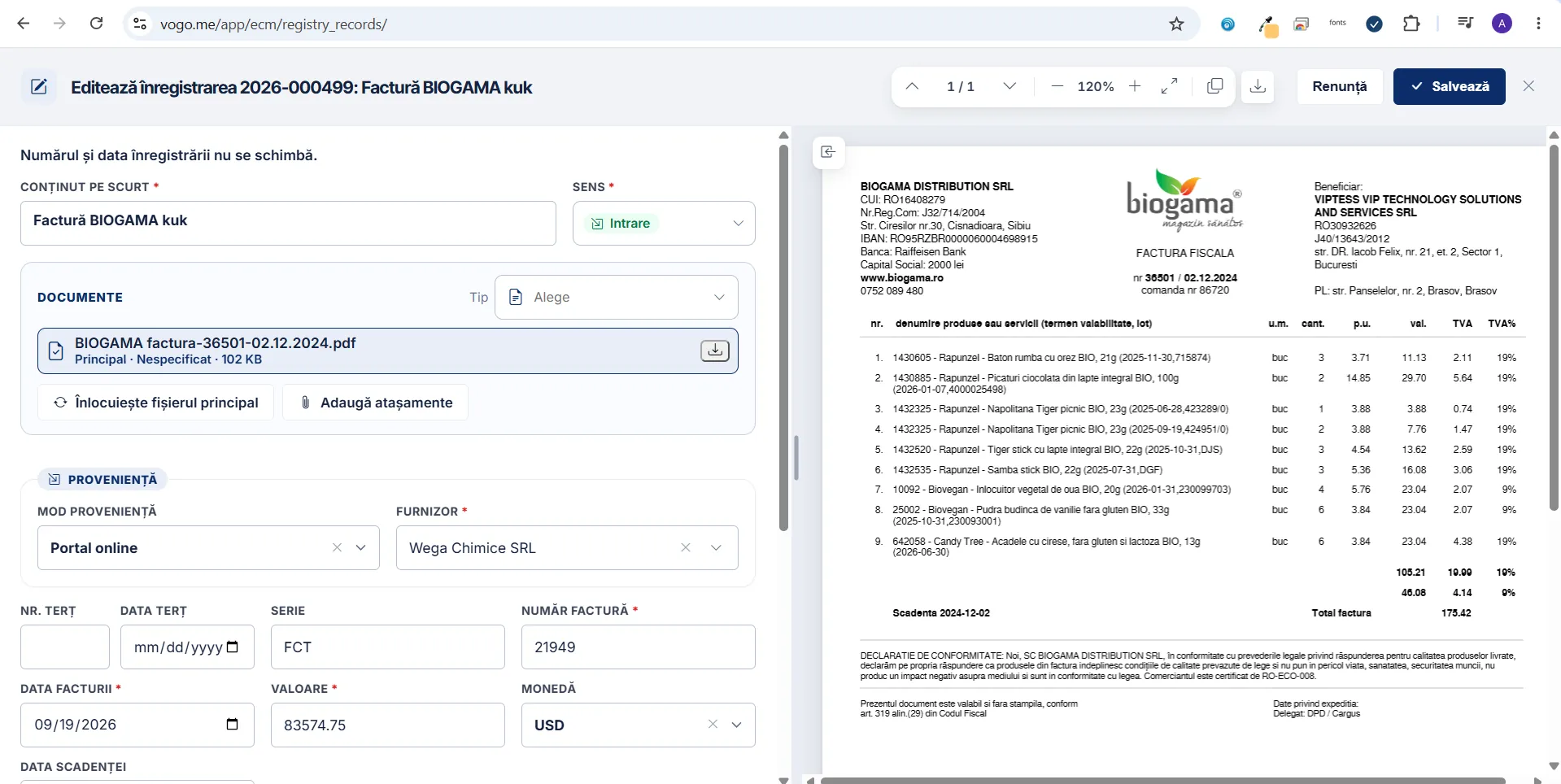
The system issues the registration number, per year and per register, each register with its own sequence. An incomplete form consumes no number.
Every register has its own code and its list of accepted document types, checked on the server rather than in the browser.
Chosen from the institution’s org chart or from the list of external people and companies.
The date by which the answer is due sits on every entry in the register.
Both stay in the register, with the reason and the person who made them. A consumed number is never reused and an entry is never deleted.
Every operation is written to the institution’s audit log.
Viewing, registering and cancelling are separate rights, configurable per register.
Closed entries fall under the institution’s retention policies, with WORM storage and legal hold.
the registry’s recording instrument
correspondence received, kept separately
correspondence dispatched
documents between departments
partner, subject, value, duration, deadlines
Government Ordinance 27/2002
Law 544/2001
the Administrative Code
Law 176/2010
Law 176/2010
Law 361/2022
OSGG 600/2018
the rules under Law 50/1991
the rules under the National Archives Law
The institution can define additional registers, each with its own code, its own yearly sequence and its own accepted document types.
The number of requests, administrative complaints and court actions. Article 27 of the rules under Law 544/2001.
The bulletin is updated yearly; the report is published by the end of April of the following year. Article 10 of the same rules.
Petitions resolved on time, extended, redirected and closed. Article 14 of Government Ordinance 27/2002.
Kept separate from the content of the reports. Article 7(1) of Law 361/2022.
Every report is generated with date and time, archived as a document and stays reproducible for inspection. No data is entered twice.
VOGO eBS e-Registratura is available in several configurations, depending on the number of users, the storage capacity and the advanced features required.
Every package runs on the same platform. What differs is the number of users, the storage level and access to features such as OCR and AI document processing.
| Package | Users | Storage | Full OCR | Agentic AI for documents |
Warranty | Support |
|---|---|---|---|---|---|---|
| VOGO-EBS-REG-BASE | 2 | BASE | — | — | included | included |
| VOGO-EBS-REG-BASE5 | 5 | BASE | — | — | included | included |
| VOGO-EBS-REG-FULL10 | 10 | FULL | included | — | included | included |
| VOGO-EBS-REG-FULL10AI | 10 | FULL | included | included | included | included |
| VOGO-EBS-REG-FULL20AI | 20 | FULL | included | included | included | included |
| VOGO-EBS-REG-FULL40AI | 40 | FULL | included | included | included | included |
| VOGO-EBS-REG-FULLUNAI | unlimited | FULL | included | included | included | included |
| AI configuration services agent | priced per implementation, on request | |||||
| AI self diagnostics agent | included free in every subscription | |||||
VOGO eBS e-Registratura is available in the SEAP Electronic Catalogue, under items dedicated to each configuration.
The institution can select the package that matches the number of users and the features it needs and can request a demonstration of the platform before purchase.
It is the application through which the organisation registers the documents it receives and issues, gives them a number and a date, assigns them, tracks their deadlines and archives them. Paper registers are replaced by electronic ones, and every operation stays in the audit log.
Yes. The general incoming/outgoing register is one of the 20 registers delivered preconfigured, with direction, date, sender, recipient, department, deadline and the document description on the same entry.
The system assigns the number, separately for each register and each year, following the configured format and sequence. The next number is visible before registration, and a registered entry is never deleted.
Yes. The set of registers delivered covers the day-to-day activity of a public institution: petitions, requests under Law 544/2001, asset and interest declarations, whistleblower reports, urban planning, hearings, investments, personnel and archive.
Yes. The configurations are published in the SEAP Electronic Catalogue, under dedicated items. The organisation chooses the item that matches the number of users and the features it needs.
Yes. Registers are configured, not coded: their own code, number format, yearly sequence reset, document types and specific fields, without changing the application.
Request a demo and see how the platform can be configured for your institution’s flows and registers.
Note: The services are provided in line with the European DNSH principle – “Do No Significant Harm”, in accordance with Article 17 of Regulation (EU) 2020/852 on the establishment of a framework to facilitate sustainable investment and with the European Commission’s technical guidance on the application of the DNSH principle, C/2023/111.